
Six months is often mentioned when people talk about dental hygiene appointments, but it is not a timetable that suits every mouth.
The right interval between hygiene appointments depends on what is happening with your teeth and gums. Your gum health, dental history, how quickly plaque and tartar build up, and how effectively you can clean between appointments can all influence how often professional hygiene care is recommended.
For some people, an appointment around every six months may be appropriate. Others may benefit from closer professional support, particularly if gum disease is being managed. The important thing is to base the schedule on what your mouth actually needs rather than simply counting months on the calendar.
What does a dental hygienist actually help with?
A hygienist’s role extends beyond giving your teeth that freshly polished feeling.
Plaque forms continuously on the teeth. Good brushing and cleaning between the teeth can remove much of it, but areas around the gumline, back teeth, and dental work can sometimes be difficult to reach consistently.
If plaque is not removed effectively, mineralised deposits known as tartar or calculus can form. These hard deposits require professional removal.
The Oral Health Foundation’s guide to dental hygienists explains that hygienists can remove hard deposits, support gum care, provide professional cleaning and advise patients on improving plaque control at home.
The home-care advice is just as important as the professional cleaning itself. A useful hygiene appointment should help you understand where deposits are building up and how to keep those areas cleaner between visits.
Is every six months the right interval?
Not necessarily.
Muse Dental’s hygiene guidance notes that teeth cleaning appointments are generally recommended around every six months, while also making clear that frequency varies according to individual oral-health needs.
Six months can therefore be a useful starting point, but the interval should still reflect your oral health.
Someone with healthy gums, minimal tartar and effective daily cleaning may have very different needs from someone who has:
- Persistent gum inflammation
- A history of periodontitis
- Rapid tartar build-up
- Dental work that is difficult to clean around
- Areas that repeatedly collect plaque
- Difficulty maintaining effective cleaning at home
Another person’s hygiene schedule is therefore not a reliable guide to what you need.
The signs your schedule may need reviewing
You do not need to wait for your teeth to feel dirty before discussing another hygiene appointment.
Several changes can suggest that your current routine or appointment interval deserves another look.
Your gums bleed repeatedly
Repeated bleeding during brushing or interdental cleaning can be a sign of gum inflammation and is worth having assessed.
It does not automatically mean you have gum disease, and occasional bleeding can have different causes. What matters is whether it keeps happening.
Our guide to why gums bleed when brushing explains some of the possible reasons and why ongoing bleeding should not simply be ignored.
Tartar returns quickly
Some people notice hard deposits returning sooner than others, often in places where plaque repeatedly collects.
If tartar develops in the same areas between appointments, simply removing it each time is only part of the answer. It may also be useful to review how those areas are being cleaned at home.
Your gums have previously needed treatment
A history of periodontitis changes the conversation.
Once someone has completed active treatment for periodontitis, ongoing supportive care may be recommended to help maintain periodontal stability.
The SDCEP guidance on supportive periodontal care recommends individually determined maintenance intervals of between 3 and 12 months following active periodontal treatment, depending on clinical history, risk and individual circumstances.
That range applies specifically to supportive periodontal care. It should not be interpreted as a general recommendation that everyone needs a hygienist appointment every three months.
Cleaning certain areas is difficult
Crowded teeth, fixed retainers, bridges and other dental work can create areas where plaque control is more challenging.
More frequent appointments are not always the solution. Improving how these areas are cleaned at home may be equally important.
Your dental team can advise on suitable interdental cleaning methods and techniques for the spaces and dental work you have.
What determines how often you should see a hygienist?

Rather than thinking only in terms of three, six or twelve months, it is more useful to look at the factors behind the recommendation.
| Factor | Why it matters |
| Gum health | Bleeding, inflammation, periodontal pockets or previous disease may require closer monitoring |
| Plaque control | Repeated build-up may show that some areas are being missed |
| Tartar formation | Some people develop hard deposits more quickly than others |
| Dental history | Previous gum treatment can affect ongoing maintenance needs |
| Dental work | Bridges, retainers and other restorations may make some surfaces harder to clean |
| Home-care ability | Dexterity, technique and suitable cleaning tools can influence plaque control |
| Changes over time | Your needs may change as your oral health or dental work changes |
Your hygiene interval is therefore something that can be reviewed over time rather than a permanent number assigned once and never reconsidered.
What about people with gum disease?
A history of gum disease can be an important factor when deciding how closely hygiene and periodontal care should be monitored.
Gingivitis affects the gums and is commonly associated with plaque-related inflammation. Periodontitis is a more advanced condition involving the tissues that support the teeth.
For people who have been treated for periodontitis, supportive care can form an important part of maintaining periodontal health. The interval is based on individual clinical findings rather than being fixed for everyone.
This is why saying, “I go twice a year” does not necessarily tell us whether someone’s gum-care schedule is appropriate.
A six-month interval may be suitable for one person, while someone else may need appointments at a different frequency because of their periodontal history and current level of disease risk.
Most day-to-day plaque control happens between appointments
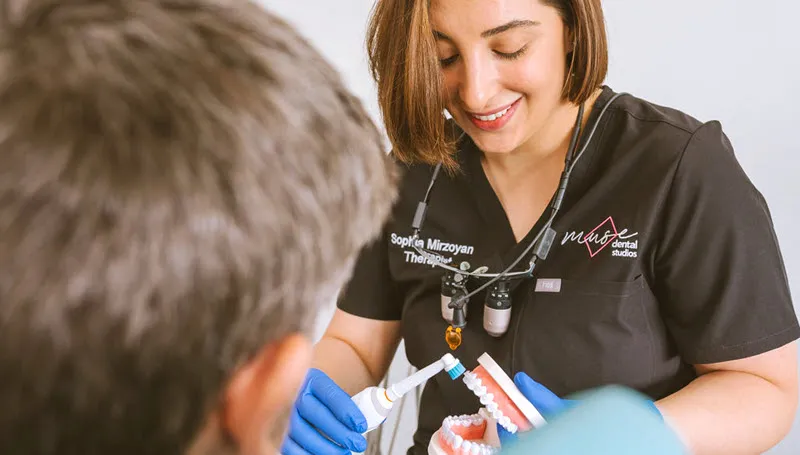
Professional hygiene care works alongside, rather than replaces, regular cleaning at home.
Between appointments, the foundations remain straightforward:
- Brush twice a day with fluoride toothpaste
- Clean carefully around the gumline
- Clean between the teeth using the method recommended for your needs
- Follow any specific technique advice given by your dental team
- Avoid assuming that harder brushing means better cleaning
- Mention persistent bleeding, swelling or other changes when you attend
The UK Government’s oral hygiene guidance supports twice-daily brushing with fluoride toothpaste and provides preventive guidance on plaque control and cleaning between the teeth.
Consistency matters far more than trying to compensate with extra brushing immediately before an appointment.
Does a hygienist appointment replace a dental check-up?
No. The two appointments have related but different purposes.
Hygiene care is primarily focused on plaque control, professional cleaning, gum health and preventive advice.
A dental examination looks more broadly at your oral health and may involve assessment of your teeth, gums, existing restorations and other areas of the mouth depending on your circumstances.
This distinction also matters when talking about appointment frequency. UK preventive guidance supports individualised oral-health recall based on need and disease risk, but this does not mean that your dental examination interval automatically determines how often you require hygiene treatment.
Your check-up schedule and your hygiene schedule may be related, but they are not necessarily identical.
If you would like to know more about routine examinations, our guide to how long a dental check-up takes explains what may be assessed and why appointment needs can differ.
What happens at a Muse Dental hygiene appointment?
At Muse Dental, our hygiene service includes gum health assessment, professional cleaning and oral-health advice.
We use Guided Biofilm Therapy with EMS Airflow as standard for hygiene appointments. The service page also describes personalised advice around brushing, flossing and dietary habits as part of the preventive care available.
What you require will still depend on your individual oral health.
If you are unsure whether your current schedule is right for you, visit our dental hygiene service page to learn more about the care available and arrange an assessment if needed.
When should you seek advice before your next planned visit?
Routine intervals make sense when your mouth is stable. New or worsening symptoms are different.
Seek advice from a dental professional rather than simply waiting for your next planned hygiene appointment if you notice:
- Persistent or worsening gum bleeding
- Swollen or painful gums
- A tooth becoming loose
- New or worsening gum recession
- Persistent swelling
- Significant unexplained pain
- Another noticeable change in your mouth that concerns you
These symptoms do not tell you what the diagnosis is. They simply mean that professional assessment may be appropriate rather than trying to diagnose or manage the problem yourself.
Rapidly increasing facial swelling or difficulty breathing or swallowing requires urgent medical attention.
Three questions that can help you understand your hygiene schedule
Instead of asking whether everyone should visit a hygienist every six months, it may be more useful to consider three questions.
Are your gums currently stable?
If there is ongoing inflammation, repeated bleeding, or a history of periodontitis, your needs may differ from those of someone with consistently healthy gums.
Are you keeping plaque under control between visits?
Repeated plaque or tartar build-up may be a reason to review both your home-cleaning technique and your professional maintenance schedule.
Has your dental team recommended a particular interval?
If they have, understanding why that interval has been suggested is more useful than comparing your appointments with somebody else’s.
Their three-month schedule may be appropriate for them but not necessarily appropriate for you.
How often should you book a dental hygienist appointment?
There is no universal number that answers how often you should see a dental hygienist for every patient.
Around six months may be appropriate for some people, while others may need closer maintenance because of their gum health, plaque levels, or periodontal history. People with consistently stable oral health may be advised differently.
The goal is not to attend as often as possible. Nor is it to stretch appointments out simply because nothing hurts.
The most appropriate schedule is one based on your current gum health, dental history, home care and professional assessment, with the interval reviewed if your needs change.
This article provides general information and is not a substitute for personalised dental advice, diagnosis or treatment. The appropriate frequency of dental hygiene care depends on individual oral health, dental history and clinical findings. If you have persistent bleeding, swelling, loose teeth, significant pain or other ongoing concerns, seek advice from a dental professional.