
This article provides general information and is not a substitute for an individual dental or orthodontic assessment. Treatment suitability, risks, expected outcomes, timescales and costs vary between patients and should be discussed with the dental professional responsible for your care.
For adults comparing Invisalign vs braces, neither treatment is automatically better. Clear aligners can be a good fit if you value discretion and the freedom to remove your appliance for meals and cleaning. Fixed braces may provide greater control for certain movements or more complex treatment plans, although suitability depends on the individual case.
The decision should come down to more than appearance. Your tooth positions, bite, oral health, the movements required and how treatment fits into your daily routine all matter. A proper clinical assessment is therefore more useful than choosing an appliance from photographs or advertising alone.
Invisalign vs braces at a glance
Both approaches apply controlled forces to move teeth gradually, but they do so differently.
| Factor | Invisalign | Fixed braces |
| Appearance | Clear and discreet | More noticeable, although less visible fixed options are available |
| Removable? | Yes | No |
| Eating | Removed for meals | Some hard or sticky foods may need to be avoided |
| Cleaning | Removed for brushing and interdental cleaning | More care is needed around brackets and wires |
| Patient responsibility | Consistent wear is essential | Does not depend on remembering to replace the appliance |
| Complex movements | Can treat many cases, but suitability varies with the movements required | May be preferred where greater mechanical control is needed |
| Retainers afterwards | Usually required | Usually required |
A recent systematic review and meta-analysis comparing clear aligners with fixed appliances included 15 trials involving 1,084 patients. It found no significant difference in treatment quality or duration in the non-extraction cases studied, while fixed appliances produced better treatment quality in the extraction cases included in the review.
The researchers also noted variation between studies and limitations in the available evidence. Importantly, the review considered clear aligners as a treatment category rather than Invisalign alone, so its findings should not be treated as proof that one branded system will produce the same result for every patient.
Oral health comes before the choice of appliance
Orthodontic treatment generally requires healthy teeth and gums, so existing dental or gum problems should be assessed before treatment begins.
Poor oral hygiene can increase the risk of problems during orthodontic treatment, while active gum disease may need to be treated and stabilised before teeth are moved. The British Orthodontic Society’s guidance on orthodontic treatment risks also highlights the importance of maintaining good oral hygiene throughout treatment.
This is one reason an in-person dental assessment matters. Choosing between two appliances is only part of the conversation.
When Invisalign may suit an adult better
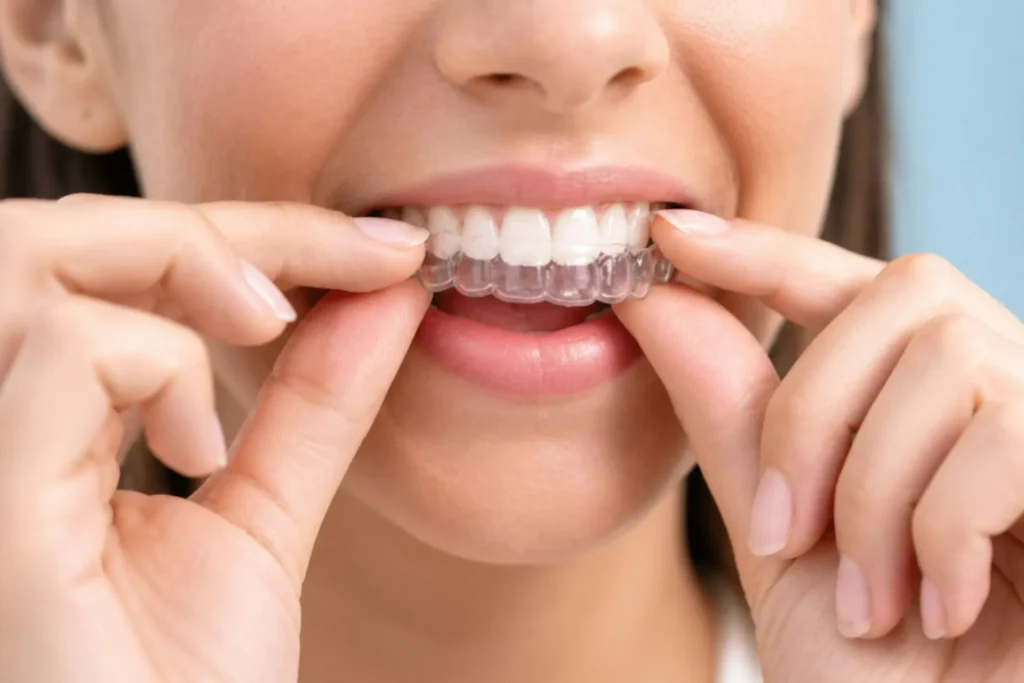
For adults concerned about wearing visible braces at work or socially, appearance can understandably influence the decision.
Invisalign aligners fit closely over the teeth and are designed to be less noticeable than conventional fixed braces.
You prefer a more discreet appliance
Invisalign aligners are transparent, although tooth-coloured attachments may sometimes be placed on certain teeth to help produce planned movements.
If a removable, discreet option appeals to you, our Invisalign treatment page explains how we assess suitability and what treatment involves at Muse Dental.
You want to remove your appliance for meals
Clear aligners are removed when eating, so there are generally fewer food restrictions than with fixed braces.
Clear-aligner treatment depends partly on wearing the aligners as instructed, alongside appropriate diagnosis, treatment planning and clinical monitoring. The British Orthodontic Society’s clear aligner guidance explains why assessment and consistent wear are important parts of treatment.
Your ability to follow the prescribed wear schedule is therefore an important part of deciding whether a removable appliance is practical for you.
You want easier access when cleaning your teeth
Taking aligners out allows you to brush and clean between your teeth without working around brackets or wires.
That does not remove the need for careful oral hygiene. Teeth should be cleaned properly before the aligners go back in, and any concerns with your teeth or gums should be assessed during treatment.
When fixed braces may be more appropriate
Fixed braces remain an important option for adults. Because they stay attached throughout treatment, they do not depend on you remembering to put the appliance back in.
Your case needs more complex tooth movement
Clear aligners can be used for many orthodontic problems, but their suitability and predictability vary with the movements required.
Severe crowding, cases involving extractions and certain complex tooth movements may require additional techniques or make fixed appliances more appropriate. This is one reason an examination of the bite and tooth positions is more useful than choosing an appliance from photographs alone.
Our fixed and discreet braces options provide an alternative for people whose treatment needs or preferences make fixed appliances more appropriate.
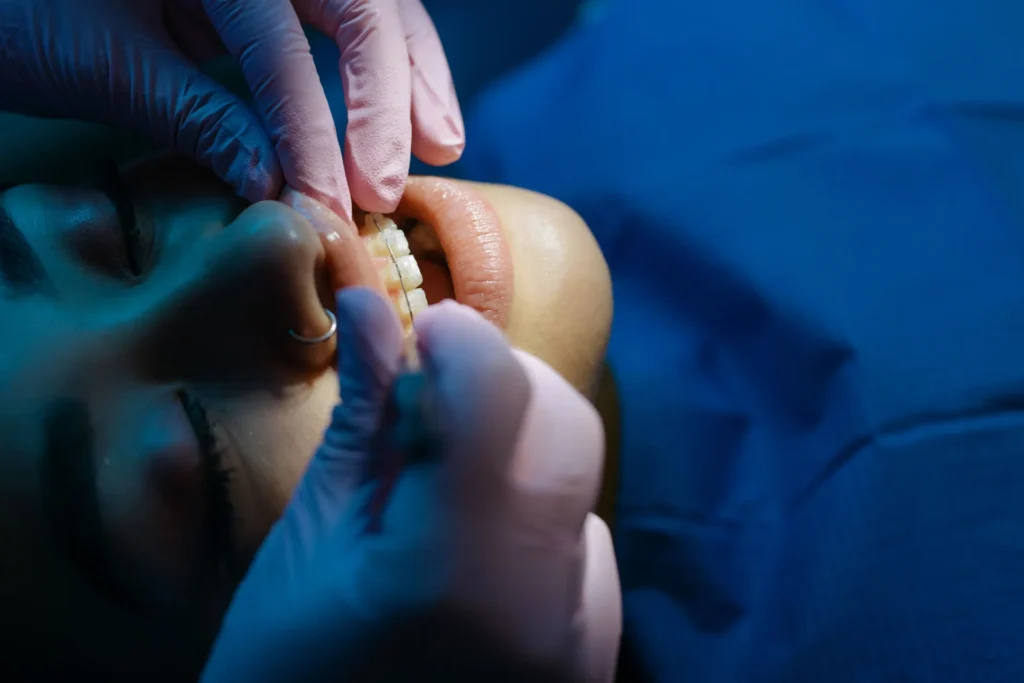
You would rather not manage daily wear
Fixed braces stay in place throughout active treatment. There is no need to remember to replace them after eating.
You do, however, need to clean carefully around brackets and wires and avoid foods that could damage the appliance.
For some adults, that routine may be easier to manage than meeting the wear requirements of removable aligners.
Which is more comfortable?
Temporary tenderness or discomfort can occur with either treatment, particularly after an appliance is fitted, adjusted or changed.
With clear aligners, pressure may be more noticeable when moving to a new set. With fixed braces, teeth can feel tender after adjustments, and brackets or wires may sometimes irritate the lips or cheeks.
Comfort varies between people, so neither treatment should be chosen on the expectation that it will be pain-free.
If discomfort is severe, persistent or associated with another dental problem, you should contact the dental professional responsible for your care rather than assuming it is simply part of treatment.
Is Invisalign faster than braces?
Not necessarily.
Treatment time depends on the starting position of the teeth, the movements required, biological response and the complexity of the case. With clear aligners, following the prescribed wear schedule can also affect progress.
Research comparing clear aligners with fixed appliances does not support a general claim that aligner treatment is always faster. In the systematic review discussed earlier, treatment duration was not significantly different between the clear-aligner and fixed-appliance groups in the non-extraction cases included.
If treatment length is an important consideration, our guide to how long Invisalign takes to work explains why timelines vary.
An individual estimate should only be made after your teeth and bite have been assessed.
How do Invisalign and braces compare on cost?
Cost cannot be compared reliably without knowing the complexity of the case and what each treatment plan includes.
Factors that may affect the overall fee include:
- the amount and type of tooth movement required
- whether one or both arches need treatment
- the appliance selected
- expected treatment duration
- whether additional stages or refinements are required
- what follow-up care and retention are included
When comparing treatment plans, check what the quoted fee includes, such as reviews, refinements or retainers, and whether any additional charges could arise.
The General Dental Council’s standards on consent require dental professionals to explain relevant treatment options and possible costs so patients have the information they need before agreeing to treatment.
Price alone cannot establish which appliance is clinically appropriate or what is included in a treatment plan.
Five questions to ask before choosing Invisalign or braces
Appearance matters, but your consultation should also establish what needs to move and whether both options can achieve it.
Consider asking:
- Are both treatments suitable for my teeth and bite?
If not, ask what makes one option more appropriate. - What movements are required?
Straightening the visible front teeth is not necessarily the same as correcting how the upper and lower teeth meet. - What will treatment require from me day to day?
Clear aligners depend on consistent wear. Fixed braces require careful cleaning and some changes to food choices. - What is included in the proposed fee?
Ask about reviews, refinements, retainers and whether any additional charges could apply. - What happens after active treatment finishes?
Retention should be discussed before treatment starts, not only when your aligners or braces come off.
These questions give you more useful information than simply asking which appliance is newer or less noticeable.
Do you need retainers after Invisalign or braces?
Retention is normally part of both treatment routes.
Teeth have a tendency to move after orthodontic treatment. The British Orthodontic Society’s guidance on retainers explains that retainers are needed in almost all orthodontic cases to help reduce relapse.
Depending on your individual treatment, you may be advised to use a removable retainer, a fixed retainer or a combination of the two.
The type of retainer and how long you should wear it need to be discussed as part of your treatment plan.
Choosing the right teeth-straightening treatment for you
For adults, the better choice between Invisalign and braces depends on the clinical problem being treated as much as personal preference.
Clear aligners may make sense when discretion and removability are priorities, and the required tooth movements can be managed appropriately with that approach. Fixed braces may be more suitable where greater mechanical control is needed or where consistently following a removable-aligner wear schedule would be difficult.
At Muse Dental, our teeth-straightening service is led by Dr Dave Stone (GDC 210329). We offer Invisalign clear aligners, clear ceramic braces and traditional fixed braces, with the available options discussed according to factors such as your bite, case complexity and lifestyle.
If you are considering straightening your teeth, explore our teeth straightening treatments to see the options available. You can then arrange an assessment with us to discuss which approaches may be suitable, what treatment would involve and the likely costs before deciding how to proceed.